
Between Al-Bāh and Shunga: How Colonialism Killed Queer Erotic Imagination
Musa Al-Shdeedi
Shunga, or “spring pictures,” are illustrated Japanese sexual storybooks written and drawn as instructional or therapeutic erotic works that physicians recommended in cases of sexual difficulties. They were sometimes presented as wedding gifts to future brides or to young men about to marry. Alongside this, they also played an entertainment role, depicting amusing, satirical stories marked by comic exaggeration—even in the way sexual organs were portrayed—as well as serving purposes of solitary sexual pleasure.
The earliest documentation of Japanese Shunga dates back to the Heian period (794–1192), but most works at that time were held by the upper classes. With the development of woodblock printing, they were produced in the thousands during the Edo period (1600–1868) and became accessible to the public.
While books on al-bāh were circulating throughout the Islamic world in similar ways and for similar purposes, in Rujūʿ al-Shaykh ilā Ṣabāh fī al-Quwwa ʿalā al-Bāh, (The Return of the Sheikh to His Youth in Power over Al-Bah) written in 903 AH / 1489 CE at the suggestion of Sultan Selim I, sexual vigor appears as a springtime in a person’s life, and the book offers a promise of returning to it through sexual techniques, various medicinal herbs, and erotic tales. The author explains their purpose, saying: “We have mentioned erotic tales and the stories of singing-girls that stir the desire of whoever seeks intercourse, awaken his lust, and assist him in his pleasure” (Pasha, 20210: 7). Between 1799 and 1817, Shaykh Muṣṭafā al-Maṣrī produced drawings of those sexual positions and stories in their Ottoman translation for the same purpose — to arouse the Muslim viewer upon looking at the illustration. Among them were drawings of sodomy, group, and lesbian sex.
Likewise, the book of the Tunisian marriage-court judge Muḥammad Al-Nafzāwī (d. 725 AH) on Baah, titled al-Rawḍ al-ʿĀṭir fī Nuzhat al-Khāṭir (The Fragrant Garden in the Stroll of the Mind) -its name also evokes spring- was also written in the early fifteenth century. In 1850, a French general carried a copy of the book with him from Algeria, and it made its way to Europe. In 1939, the Nazis confiscated all editions of the book in the European lands they occupied and burned them all because of its “obscenity” (Al-Nafzawi, 1993:12).
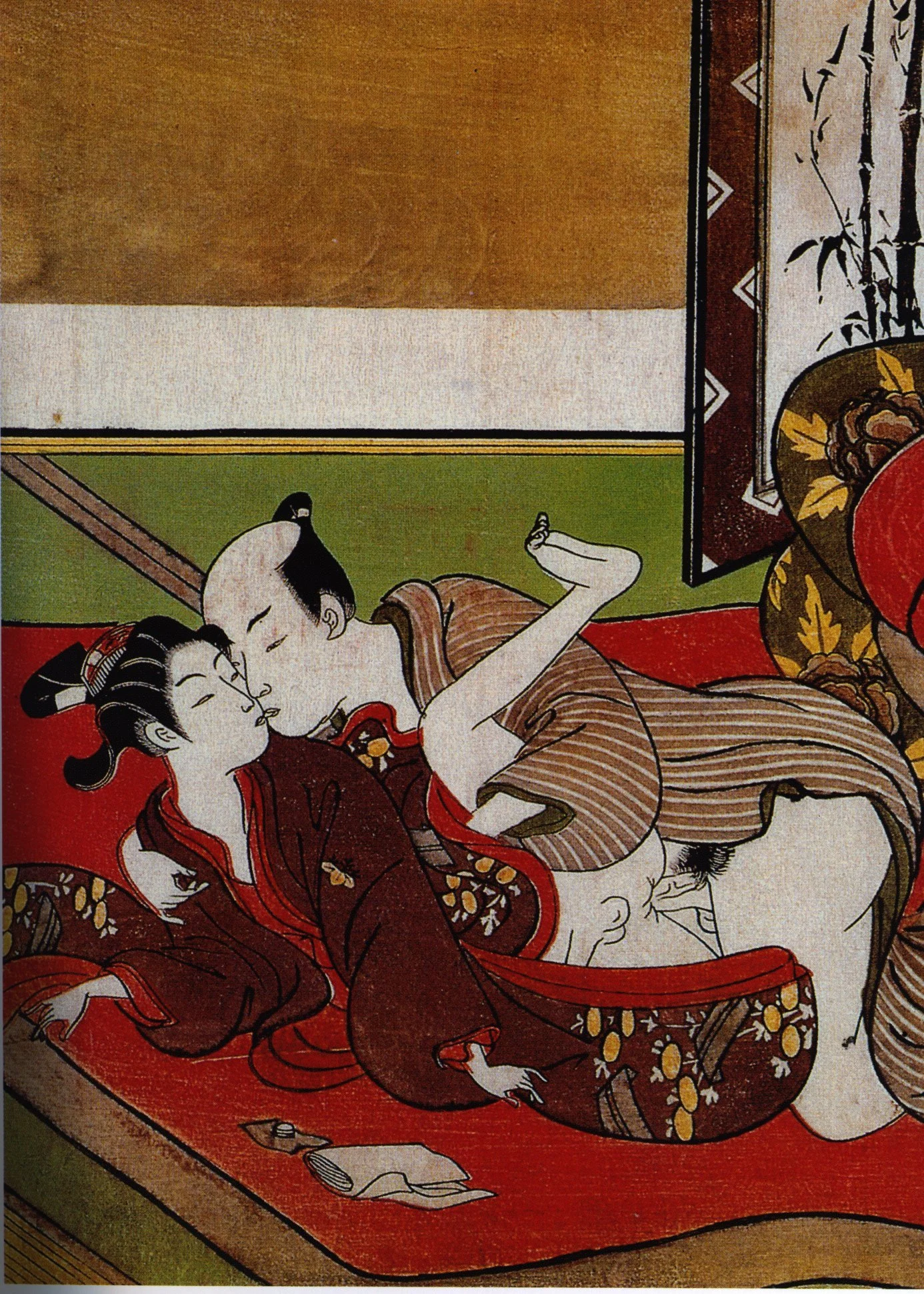
Suzuki Harunobu, series of 24 erotic prints Mid- eighteenth century c. 1750 Victoria and Albert Museum, London
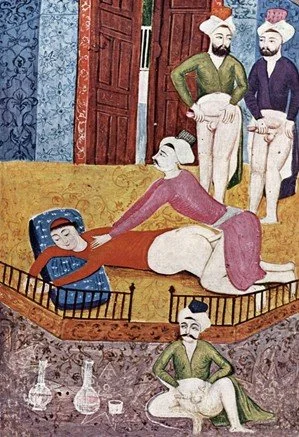
A manuscript of Nevʾī-zāde ʿAtāʾī’s H˘amse (Pentalogy). 1103 AH/1691 CE, Turkish and
Islamic Art Museum, Istanbul, Ms. 1969, f. 55v.
Western revulsion
Shunga did not appeal to Westerners from the very first encounter in 1614 when a shunga painting was seized by John Saris, the captain of an East India Company ship, which was loaded with armor and silk tapestries from Japan. The Company auctioned off all the goods and confiscated the painting, as displaying it would have offended the sensibilities of conservative English society. The Company later destroyed it.
In 1637, missionary activity was banned in Japan, and the shogun (the military rulers), fearing Western Christian colonial ambitions, prohibited all foreigners from entering the country, isolating it from the outside world.
During this period of isolation, a subculture of male–male eroticism flourished among monks and warriors (Smalls, 2002). Missionary activity remained banned until 1871 (one year before the criminalization of homosexuality in Japan), when the concept of freedom of belief was introduced as part of the Meiji reforms, giving Christian missionary groups a legal space in which to organize.
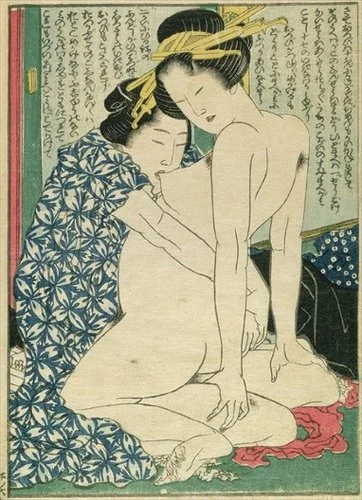
Japan, Hokusai-Gods of Myriad Conjugal Delights 1821, https://www.art.salon/artwork/katsushika-hokusai_manpuku-wagojin-the-gods-of-conjugaldelights-c-1821_AID46896
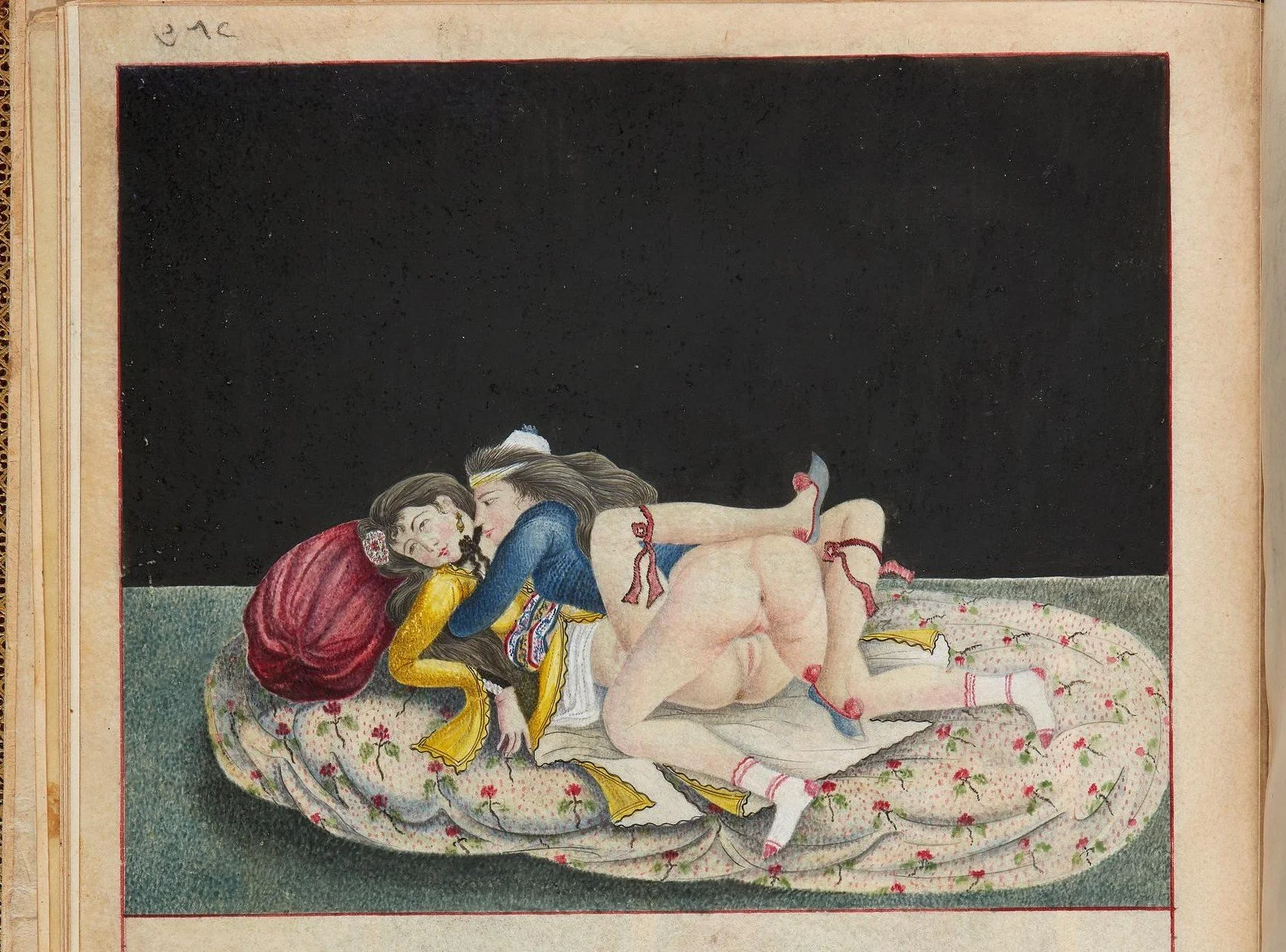
Ottoman Empire; between 1799 and 1817, Each leaf: 32.2 x 20.5 cm, Inventory number 8/2018, Davids collection, https://davidmus.dk/art-from-the-islamic-world/miniature-paintings/item/1734?culture=en-us
When Westerners encountered Muslim rulers who engaged in sodomy, they were shocked. During a British envoy to Persia, Thomas Herbert, who served between 1626 and 1629, described his first entry into the court of Shah Abbas the Great of the Safavid dynasty, noting the presence of young cupbearers serving wine in the palace. He focused on their femininity, dance movements, and overt sexual suggestiveness (Boone, 2014). Similarly, the Italian orientalist and traveler Pietro Della Valle, in 1617, commented on the ‘lascivious postures’ of the figures depicted on the walls of Shah Abbas’s summer residence.
Pederastic scenes were a common subject for miniatures that were sold in public markets. Islamic art historian Christiane Gruber wrote, ‘That either would have had access to erotic art in the bazaars of Tehran or Isfahan comes as little surprise, since such works were readily available to foreign tourists from at least the early nineteenth century onward. Within their travelogues, a number of French and British travelers, scholars, and diplomats in fact offer brief words on the availability of such images in Iran. For instance, J.M. Tancoigne states that “´indecent´” subjects were copied at this time (Leoni & Natif, 2013).
Horatio Southgate, an American Episcopal priest serving as a missionary in ‘the dominions and dependencies of the Sultan,’ admonishes the readers of his Travels (1840) lamenting the ‘vice’ of same-sex love that has ‘deeply stained’ the ‘Eastern character,’ he described homoerotic miniatures as ‘indecent scenes of the most infamous description,’ which he has seen for sale in Istanbul shops.
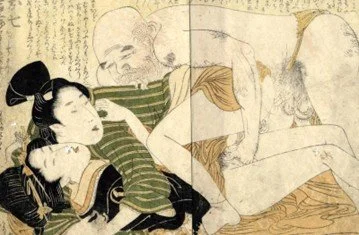
Kyōwa 2, Love-Intensified Lady Torisao, Kitagawa Utamaro, (1802), Genuine, Ukiyo-e.
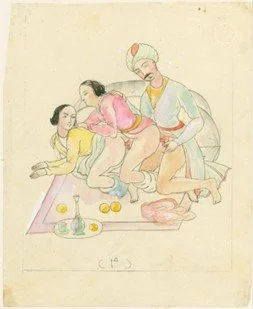
Persian (early 20C). Courtesy of the Kinsey Institute for Research in Sex, Gender, and
Reproduction, Bloomington, IN.
During this period, the Japanese authorities tried to suppress certain shunga works that, in the eyes of outsiders, exposed the country and its ruling class to sexual accusations. Rachel Ritchie tells us in her article “Shunga: Erotic Art in the Tokugawa Era” that the shift of shunga production into secrecy under these restrictions rendered the restrictions largely ineffective. The authorities, for their part, seem to have turned a blind eye to prints that contained no political content (Redjou, 2016).
Despite how strict the laws were on paper, “publishers and artists continued to return to producing works due to the high demand for sexual prints.” They hid their names through puns or dialogue—for example, Kitagawa Utamaro inserts his own name into the dialogue of one of his 1790 works (Keukelaar, 2022).
When Westerners re-entered Japan, they repeated their disgust toward shunga. The American businessman Francis Hall recorded in his diary upon arriving in Yokohama in 1859 his opinion of the shunga shown to him by some Japanese friends: “vile pictures executed in the best style of Japanese art” (Hayakawa & Gerstle, 2013: 26).
He is then invited to an elegant home, where a Japanese couple shows him some of their treasured possessions that impress him. The husband then goes to a drawer and brings out something precious, and Hall suddenly finds four “obscene pictures” in his hands. He is puzzled by the wife’s presence, by the couple’s lack of shame in showing him such images, and shocked by how carefully they preserved them. He then sees erotic images painted on porcelain dishes and some masks, prompting him to remark that they were “evidence of the depraved taste of this people” (Hayakawa & Gerstle, 2013: 26).
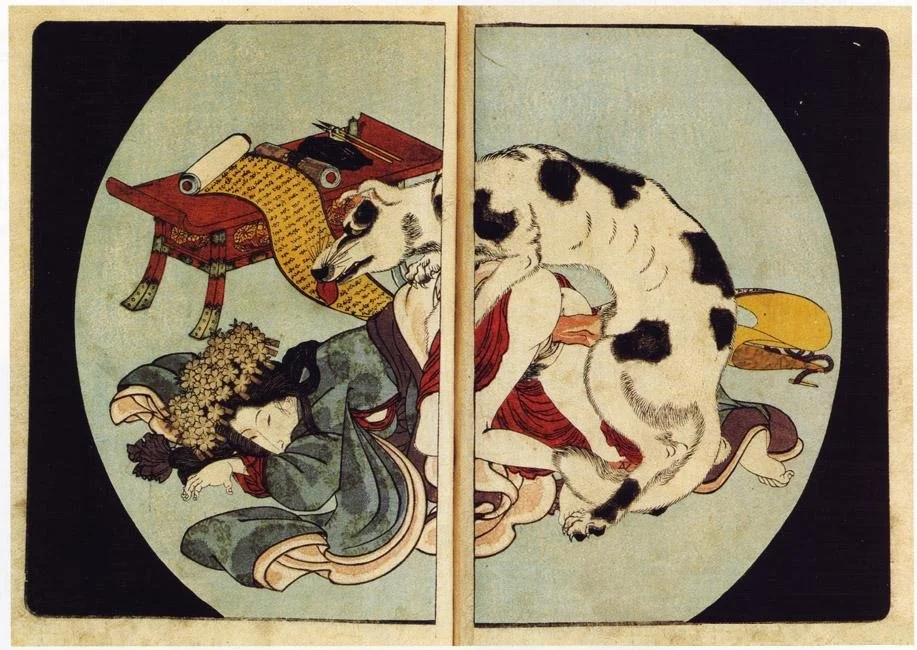
Princess Fusehine making love to the dog hero Yatsufusa‘ (c.1837) from the series ‘Koi no
Yatsu Fuji (lit.‘The Love of Yatsufuji’)‘ by Utagawa Kunisada (1786-1865), Beate Uhse Erotic
Museum Berlin.
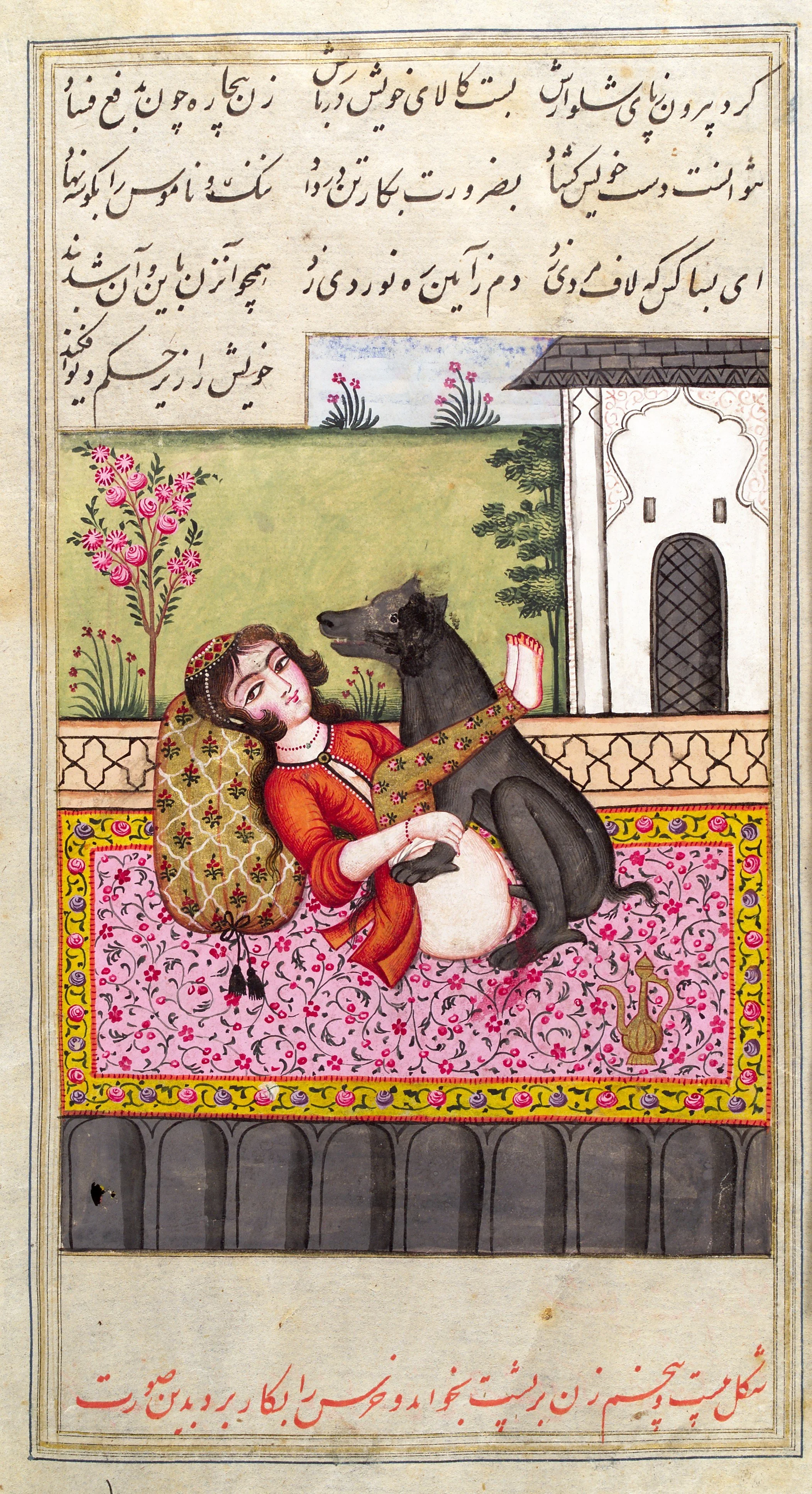
Persia, 9th century AD, and probably of Isfahan. Library reference: WMS Persian 223 Wellcome L0033282 https://wellcomecollection.org/works/ff5ghuv2
This suggests that all attempts at prohibition failed to alter the Japanese public’s positive attitude toward Shunga; Yet this Japanese tolerance in displaying Shunga images before strangers as works worthy of appreciation could not withstand the arrogant, disgusted gaze of the West.
The spread of Western homophobia
With the 1854 invasion of Yokohama by U.S. naval officer Matthew Perry, the free expression of same-sex erotic practices in both art and everyday life came to an end. Alongside the influx and growing acceptance of Western ideas in Japan came homophobia and sex-negativity.
In 1886, the British Orientalist and Africa scholar Richard F. Burton (1886: 225) observed: “In the present age, extensive intercourse with Europeans has produced not a reformation but a certain reticence amongst the upper classes: they are as vicious as ever, but they do not care for displaying their vices to the eyes of mocking strangers.”
This shift was observed on a local level as well. After the Crimean War (1853-1856), Ahmed Safavi Pasha (1980: 9) recorded that “well-known love for and relationships with the young men of Istanbul was transferred to young women as the natural order of things.”
Afsaneh Najmabadi (2005: 4) said ‘As “another gaze” entered the scene of desire, Iranian men interacting with Europeans in Iran or abroad became highly sensitized to the idea that their desire was now under European scrutiny. Homoerotic desire had to be covered. One marker of modernity became the transformation of homoeroticism into masqueraded het- eroeros.’ This influenced Qajar visual art and caused the change in the visual manifestation of desire and, consequently, in the collective Iranian imagination.
In 1868, Emperor Meiji succeeded in overthrowing the last shogun and consolidating his rule over the country. His reign marks the only period in Japanese history during which homosexuality was criminalized. Historians refer to this era as “the Japanese Furnace”, due to Japan’s openness to Western Christian influence and the establishment of Japan as a modern nation-state.Japan became preoccupied with its international reputation and public image. New laws were enacted banning shunga prints and all forms of nudity in art. Male prostitution in the theatre was abolished. Homosexuality was no longer celebrated in art, literature, or performance; instead, same-sex practices were demonized through a systematic government discourse and treated as a “national embarrassment” (Smalls, 2002: 128).
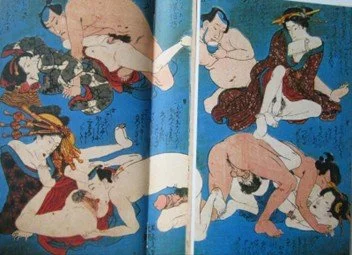
‘Koi no Yatsu Fuji (lit.‘The Love of Yatsufuji’)‘ by Utagawa Kunisada. (1786-1865)
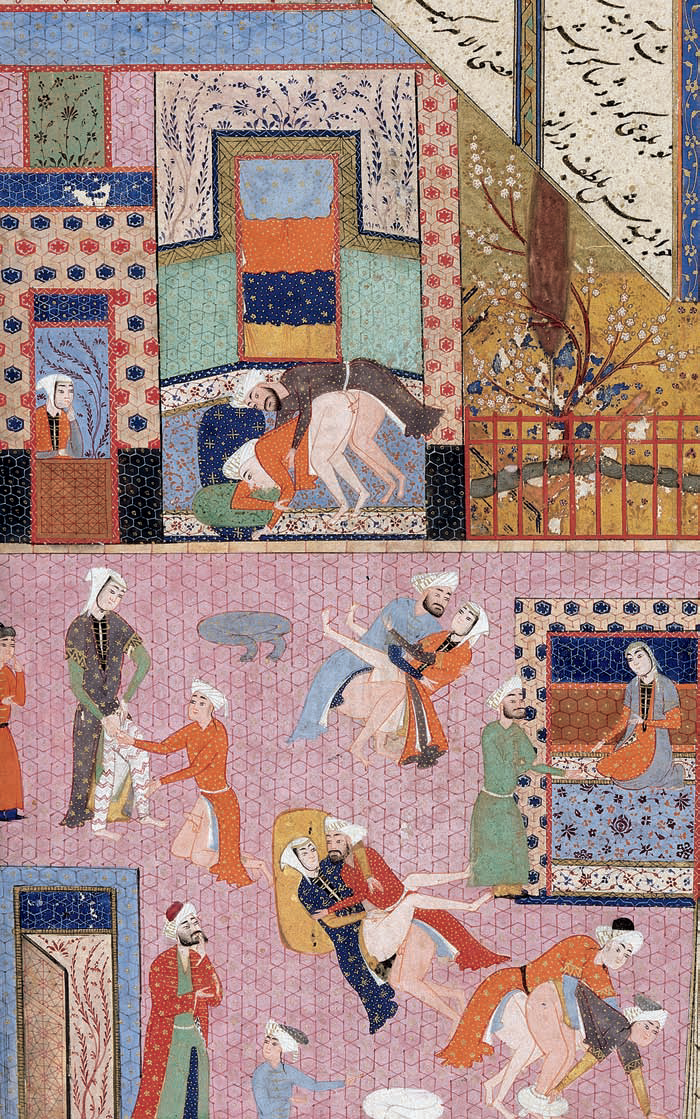
Miniature painting from the Khamsa of Nevi Zade Atai, Khamsa (Book of Mesnivis).
The Meiji Civil Code was enacted, and homosexuality was criminalized between 1872 and 1880. This criminalization was based on “civilized” standards of sexual behavior, derived from European sexual discourse and Freudian psychology. The result was the creation of binary classifications foreign to Japanese culture, defining what was considered “natural” and “deviant” sexual activity. The new standard of “civilized morality” became heterosexual intercourse within state-sanctioned marriage (Felici, 2019). In the same year, shunga and erotic toys were criminalized, and mixed public baths were closed. In 1878, single-sheet obscene prints and shunga were banned by the authorities in an attempt to further suppress shunga. Despite all this, artists continued to resist and produce shunga in secret, though not for long.
By 1905, it seems that shunga production was still an
“open” secret, but with Japan’s victory in the Russo-Japanese War and its increased international presence, shunga became completely taboo within Japanese culture. Sadly, it would not be until 1989 that shunga would once again be published in Japan in an unedited, uncensored book aimed at a small group of scholarly researchers (Redjou, 2016: 32).
In the Islamic world, the Ottoman Caliphate fell after attempting to conform to European modernity toward the end of its rule. The British and French colonized its territories and criminalized same-sex sexual practices in the new countries they created under the Sykes-Picot Agreement, with laws that largely remain in effect today, used to prohibit any erotic queer art.Japanese art and cultural historian Monta Hayokawa tells us, with regret, in his valuable article Who Was the Audience for Shunga?
Today, however, erotic images like shunga are thought to be primarily for young men or lascivious older men and remain a taboo in Japanese society. It is clear that there is a vast gulf between the Edo period and now. As Ishigami Aki shows in this issue, modern governmental suppression of shunga was gradual but eventually effective in depicting shunga as obscene pornography, and making it taboo as an academic subject (Hayakawa & Gerstle, 2013: 34).
How tragically ironic that shunga artists were able to withstand government bans for 200 years, only for Western concepts to destroy this art in just seven years of criminalization.
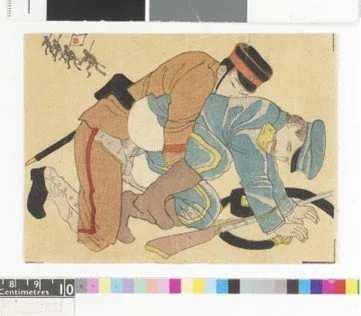
Meiji Era, 1904-1905 (circa) Number: 2012,3053.1. British museum
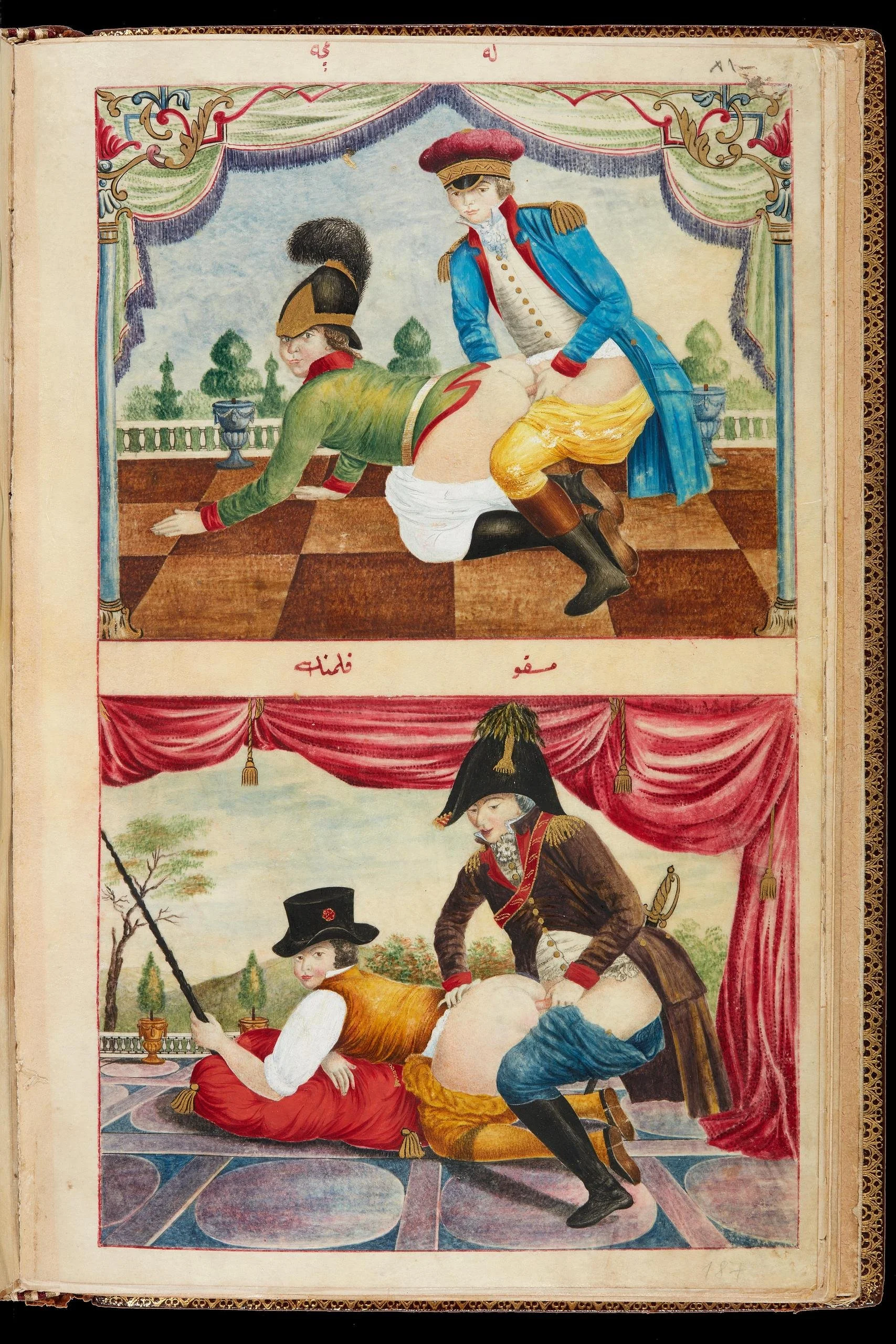
Ottoman Empire; between 1799 and 1817, number 8/2018, Davids collection, https://davidmus.dk/art-from-the-islamic-world/miniature-paintings/item/1734?culture=en-us
Colonialism of museums
After the Meiji reforms, Western imports increased, which caused a decline in local demand for Japanese art (Cortazzi, 2014). At the same time, Westerners developed an obsession with collecting Japanese artworks. The French art critic and collector Philippe Burty coined the term Japonisme in 1872, and it soon became a common label for this phenomenon, which ultimately led to many Japanese art pieces ending up in the storage rooms of Western museums (Ono, 2003).
The shunga manuscripts remained out of sight throughout the twentieth century. When Peter Webb, a specialist in erotic art, visited the British Museum in 1975 while researching his book Erotic Art, he was initially told that no such manuscripts existed in the museum’s collection. When he was finally granted access after contacting a senior official, he was informed that they “could not possibly be exhibited to the public,” and they had not even been catalogued. In other words, the museum had hidden these important manuscripts for nearly forty years, until it eventually organized an exhibition for them at last.
In the promotional video for the exhibition, the phrase “taboo in Japan for nearly a century” appears, portraying Japanese culture as closed and secretive, and presenting the museum as a savior that “rescued” these works from Japanese insularity—despite this being the complete opposite of what actually happened.
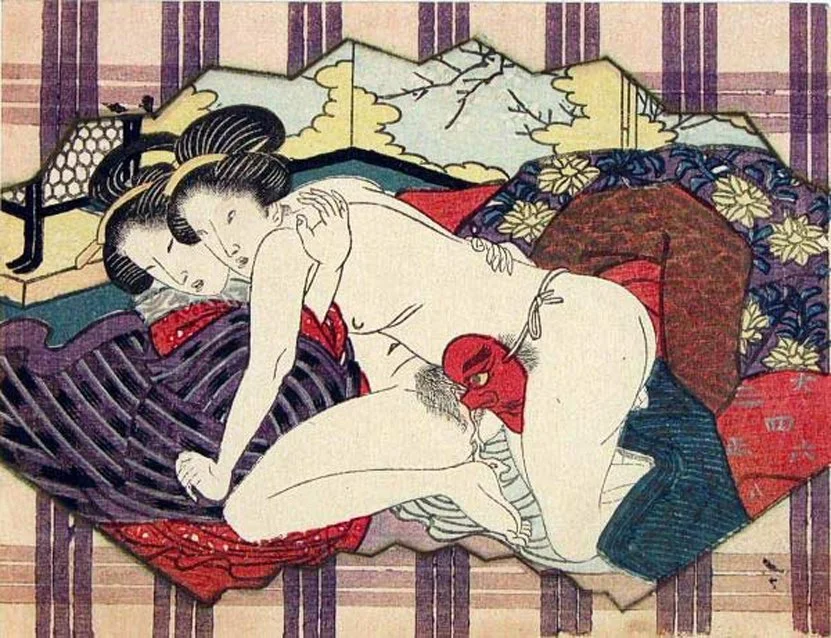
Edo period, 1500, Wikimedia Commons.
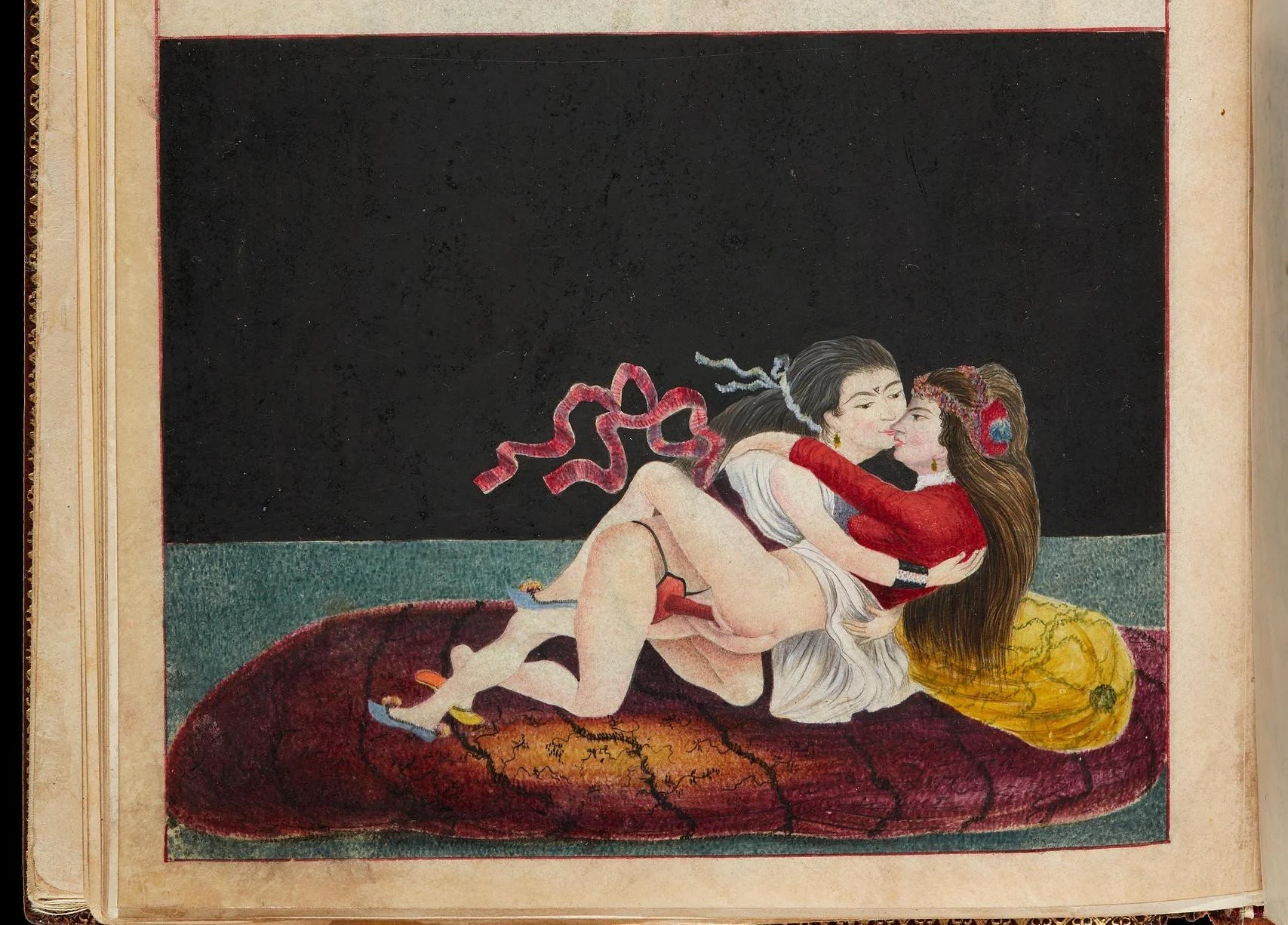
Ottoman Empire; between 1799 and 1817, number 8/2018, Davids collection, https://davidmus.dk/art-from-the-islamic-world/miniature-paintings/item/1734?culture=en-us
For example, the French Library is a massive institution whose seed was planted during the reign of King Louis XI. Like any imperial library seeking to assert its dominance over the cultures it aims to control, it systematically seized numerous Islamic manuscripts. François I sent an orientalist mission to Italy and Arabic-speaking regions to hunt down “Eastern” manuscripts and bring them back to France. The missionary Michel Vansleb alone managed to acquire 630 manuscripts from the East (Galignani, 1825).
Twenty-four illustrated and illuminated Islamic manuscripts from the collections of the National Library of Israel were displayed in the exhibition Romance and Reason: Islamic Transformations of the Classical Past, organized in collaboration with the Institute for the Study of the Ancient World at New York University (ISAW) on 14 February 2018. They were presented as evidence of Israel’s cultural richness, even though colonial projects typically seek to fabricate a history for themselves through the cultural heritage of others.British Prime Minister David Cameron expressed this clearly in a 2010 television interview during his visit to India regarding the precious Koh-i-Noor diamond, which the British had taken from India and placed in the crown of their queen. His response was: “If you say yes to one, you suddenly find the British Museum would be empty.”Today, exhibitions in Europe proudly advertise that they hold “one of the largest collections of original Japanese woodblock prints”, because the current trend is for museums to display openness and friendliness toward queer communities as part of the image the West tries to project — the defender of human rights and freedom — to justify its wars around the world.
The British Library also publishes a Pride-Month article celebrating Manuscript khamsa by Attallah Atai, with its homoerotic character, even though they still refuse to make it available to the public or allow the world to view it in full on their website.
The role Western museums play in hiding these manuscripts — which are more than consumable artworks, functioning instead as sexual heritage and historical documents that attest to the existence of erotic art long before the global right wing began denying it, and before the West colonized the world with what Foucault calls its scientific approach to sexuality — is not very different from the role of the Nazis, who attempted to erase Islamic bāh literature, nor from the role of postcolonial Arab governments, backed by the West, that burn the diwans of Abu Nuwas today because they express his love for men.Tracing the impact of colonialism on erotic visual representation through a cross–Southern perspective allows us to understand the colonial pattern of dealing with Southern eroticism in a deeper and more integrated way. Despite some differences between the two cases, the outcome was almost the same in both Japan and the Islamic world: prohibition.
It also shows that local attempts at censorship were reactions to Western colonial disgust; this shift was not the result of an “internal development” so much as a direct reflection of the dominance of an imported moral discourse embodied in missionary missions, military presence, and the “civilizing” policies imposed by colonial powers as the sole universal standard of civilization.
Recovering these arts does not only mean doing justice to queer visual heritage; it also means reclaiming the ability to imagine our bodies and desires outside the molds shaped by colonialism, and rereading our sexual histories away from narratives of shame. Shunga and the bāh books are not merely old erotic images, but testimonies to worlds that saw sexual diversity as part of human nature, not a threat to identity or morality.
Bringing this heritage back into the light is not just archival work—it is an act of resistance that restores to dispossessed cultures their right to narrate their sexual stories as they were before colonialism killed them in the name of “civilization.”
References
A. AND W. GALIGNANI (eds.). (1825). The History of Paris, from the Earliest Period to the Present Day. Volume 2. Paris: Galignani.
AL-NAFZAWI, A. (1993). Al-Rawd al-‘Atir fi Nuzhat al-Khatir (The Fragrant Garden in the Stroll of the Mind), edited by Jamal Jum‘ah, London: Riad Al-Rayyes.
BOONE, J. A. (2014). The Homoerotics of Orientalism. New York: Columbia University Press.
BURTON, R. F. (1886). ‘Terminal Essay,’ in The Book of The Thousand and a Night, trans. and ed. Richard F. Burton, Vol. 10. London: Burton Club.
CORTAZZI, Sir H. (January 16, 2014). "[Review:] Japonisme and the Rise of the Modern Art Movement: The Arts of the Meiji Period, The Khalili Collection". Japan Society of the UK. Archived from the original on August 14, 2014. Retrieved March 19, 2020.
FELICI, M. (2019). “Male Homosexuality in Japan: a history of cultural stereotypes and socio-economic constraints”. Paper presented at the University of Bologna. Available at: https://www.researchgate.net/publication/334416746_Male_Homosexuality_in_Japan
HAYAKAWA, M. & GERSTLE, C. A. (2013). “Who Were the Audiences for Shunga?” Japan Review, 26 Special Issue Shunga: Sex and Humor in Japanese Art and Literature, pp. 17-36.
KEUKELAAR, M. (2022). The Impact of the Male Gaze: Femininity and Female Sexuality in Shunga Prints of the Edo Period. Missouri: Lindenwood University.
LEONI, F. & NATIF, M (2013). Eros and sexuality in Islamic art. Surrey: Ashgate Publications.
NAJMABADI, A. (2005). Women with Mustaches and Men without beards. London: University of California.
ONO, A. (2003). Japonisme in Britain: Whistler, Menpes, Henry, Hornel and nineteenth-century Japan. New York: Routledge Curzon.
PAŞA, A. C. (1980). Maʿrūzāt, ed. Yusuf Halaçoğlu. Istanbul: Çağriı Yayıları.
PASHA, B. K. (2007). Raj‘ al-Shaykh ila Ṣabāhihi fi al-Quwwa ‘ala al-Bah (The Return of the Sheikh to His Youth in Power over Al-Bah), general supervision by Magdy Shukri, Ibda‘ Publishing and Distribution.
REDJOU, R. (2016) Shunga: Erotic Art in the Tokugawa Era. Washington, D.C.: Western Washington University.
SMALLS, J. (2002). Homosexuality in art. New York: Parkstone Press.
Musa Al-Shdeedi is an Iraqi writer and researcher focused on gender and sexuality in the Arab context, with a critical emphasis on colonial and Western epistemic influences in shaping contemporary discourses. He has published five books and contributed a number of articles to different magazines/platformes. His work seeks to deconstruct dominant narratives and re-read heritage through a postcolonial lens, combining theoretical inquiry with cultural analysis.
