
The World Cup of Narratives
Firas Kefi
On December 5, 2025, at the Kennedy Center in Washington, a draw selected four names: France, Senegal, Norway, and a playoff qualifier that would soon be known as Iraq. The press didn't wait for the ceremony to end before passing judgment. "The toughest group in the draw," they wrote immediately. "Group of Death," they whispered next. The label stuck to Group I before a single ball had been kicked, and once a name is uttered, it takes on a life of its own: it creates an expectation, a narrative, that the players have no choice but to live up to.
The Dictator
On June 22 in Philadelphia, an Iraqi defender, Merchas Doski, attempted a cheeky backheel in front of Mbappé, and the ball slipped between his legs. The celebration was short-lived: Mbappé recovered the ball immediately and returned the favor with a deft double feint that sent his opponent tumbling, before curling a shot with his weaker foot into the top corner two minutes later. Four days later, in Boston, after being substituted late in the game against a Norway team missing Haaland, he removed the captain's armband and had the referee personally pass it to a teammate of his choosing: a personal decree disguised as protocol.
On July 4, back in Philadelphia for the round of 16 against Paraguay, Mbappé faced a team that had long since chosen its path: rough play, a deep defensive block, and fouls that disrupt rhythm rather than passes that set it. This school of thought has its apostles, starting with Diego Simeone, eternally clad in black on the Atlético Madrid bench, a prophet of a style that has turned opponent frustration into an art form. This style now has a name on social media: Haramball. The word borrows from religious terminology to describe a style deemed not only ugly but illicit, and the trend has found its own soundtrack: a chanted chant whose origin leaves little room for confusion. The accompanying montages portray Simeone and his English counterpart Mikel Arteta as armed combatants in fatigues and balaclavas against a backdrop of matches lacking scoring opportunities, where hard tackles take the place of spectacle. Paraguay, on that day, became the national embodiment of this narrative: a tiny David resorting to the forbidden to save face against Goliath, without anyone ever questioning why Goliath keeps winning.
France dominated without creating much. The match came down to a penalty kick, and it was Mbappé who converted it, alone against the goalkeeper, just as he had been all evening against the Paraguayan defense. Speaking into the microphone, he didn't mention the score but rather the way they played: "If we have to get our hands dirty, we'll get our hands dirty. They thought we were going to show up in tuxedos. We know how to play dirty soccer too, and even at that, we were better than them." The next day, a Paraguayan senator, Celeste Amarilla, published a diatribe against him so openly racist that it drew condemnation from the Élysée and FIFA. From this entire sequence, the revenge nutmeg, the captain's armband, "getting our hands dirty," and the senator's racism, the myth of "Kylian Dictador" was born, a montage featuring him in military attire and Macron-style glasses, which had already racked up four million views even before the tournament began.
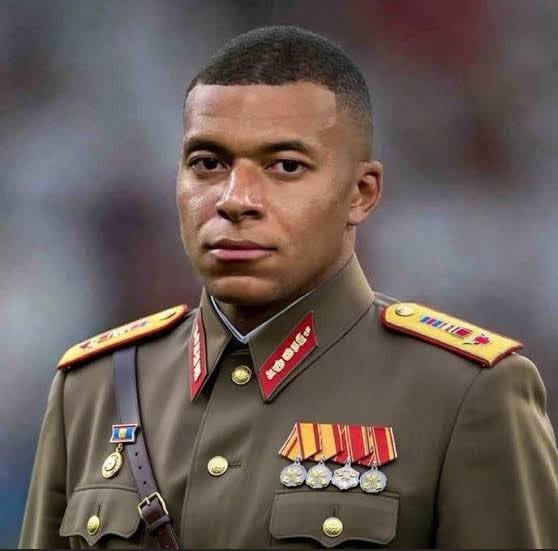
One of the “Kylian Dictator” memes.
Mbappé and Paraguay, on that day, nevertheless share a common thread easily overlooked given how diametrically opposed their narratives seem: the soundtrack. The montages of Haramball and Kylian Dictador draw from the same pool of imagery, the same martial uniforms, the same visual language borrowed from a war-like imagination we prefer not to name too precisely. The empire and the insurrection they are supposed to embody, one against the other, turn out to be cut from the same cloth. The question deserves to be asked: is this a coincidence, a simple shortage of striking images available elsewhere on the internet, or a sign that the line separating the tyrant we admire from the rebel we excuse is, in the contemporary collective imagination, much thinner than it appears?
The Cyborg
Erling Haaland is no second-rate player brought in just to make up the numbers. He is, on par with Mbappé, one of the rising stars of world soccer, one of the two or three players about whom we seriously wonder whether they will redefine the coming decade. It is this symmetry of status that makes the divergence in their narratives so telling: two men at the very pinnacle of the same sport, at the exact same moment, choose, or have imposed upon them, two diametrically opposed approaches to dominance.
On July 5 in New York, Haaland burst through the Brazilian defense and beat Gabriel, the Arsenal defender, to score a diving header that put Norway back in the game. His celebration was anything but an outburst of joy: he walked away, impassive. A few minutes later, he struck again, this time with the ball at his feet, firing a low shot just as incisive as the first. 2–1. Any kid has dreamed his whole childhood of this exact moment: scoring the winning goal against Brazil in the World Cup. Haaland just walks on. He has just secured his country's advancement almost single-handedly, and he shows no emotion. None, except for one: he makes a move to rip his jersey off Hulk-style, before changing his mind in a split second, remembering that the gesture would earn him a yellow card and possibly a suspension for the next match.
Four years earlier, that same man had posted a very different video. During the 2022 World Cup, all his Manchester City teammates had left to join their national teams, except him: Norway hadn't qualified in nearly thirty years. He was seen hanging around alone on the club's training field, playing with the tractor that marks the lines, passing his days like an idle child on summer vacation. He described the scene to Kevin De Bruyne with the quiet melancholy of a twenty-one-year-old watching others go off to war.
The myth of the cyborg was built on that seemingly endless Scandinavian physique, that efficiency that resembles a statistical datum rather than a human gesture. Such a body, today, could easily slip into the toxic imagery of unapologetic domination. Haaland does not. In his demeanor, he remains a teammate rather than a ruler, the opposite of Zlatan Ibrahimović, who, with a similar migration story, built his entire legend on a self-proclaimed aura and ego. The body is almost the same; the clothes don't make the man.
This is where the two myths of the summer part ways for good. Mbappé builds his empire through speeches, calculated gestures, and captain's armbands handed out like decrees. Haaland conquers the same summit in silence, almost apologetically, refusing the role others would have him play. One has become a dictator by talking too much; the other, a cyborg, by saying nothing at all. The two legends stand in opposition, yet both satisfy the same contemporary appetite for the strong, unchallenged leader, even though neither truly fits the mold of a masculinist movement that would nevertheless like to claim them as its own.
The Group of Death, Take Two
Let's return to the Group of Death. It is there, and nowhere else, that the dictator and the cyborg crossed paths: France and Norway were in the same Group I, doomed to face each other in the group stage before each, on its own, making it to the semifinals. But a group of four teams always has only two stars. That leaves the other two, and the question we forget to ask: what happened to the teams that had no legend to feed to the media?
Senegal, for starters, had a score to settle. In 2002, in Seoul, the Lions of Teranga had shaken up the symbolic hierarchy of world soccer by defeating the reigning world champion French team 1-0 in an opening match that remains, to this day, the last time a defending champion had the dubious honor of opening the following tournament. Twenty-four years later, a rematch. But it was the dictator himself who delivered the verdict, with a decisive 3-1 victory.
As for Iraq, it all but vanished from its own narrative. Defeated 4-1 by Norway and then 3-0 by France, it proved to be the tournament's easiest opponent. News montages linked Norway's dominant performance to the image of George W. Bush, an almost affectionate association, while no one seemed to recall what an American president had done in Iraq. The tournament's geopolitical narratives favored the more clearly defined opposition between Iran and the United States. No one thought to recount Iraq's 2003 "revenge," even though it's just as readily available as a narrative. Iraq put up a good fight overall. One could imagine a World Cup of countries invaded by the United States: the roster would barely fit on a single poster.
America, in fact, has never stopped trying to mold soccer in its own image. The mandatory hydration breaks, which divide each match into four quarters NBA-style to better accommodate advertising, are just the latest manifestation of a long-standing habit. In the 1970s, the now-defunct North American Soccer League replaced the penalty shootout with a timed one-on-one, featuring a player sprinting at full speed against an isolated goalkeeper, a format deemed more spectacular than the cold, clinical penalty kick. The idea never made it beyond the continent.

FIFA’s Infantino and Trump
Other American innovations have eventually caught on everywhere: the culture of data and statistical analysis, long mocked as a college sports gimmick, now permeates the staffs of all major European clubs. Even Trump, in the midst of a tournament he is co-hosting, managed to get FIFA to lift a suspension for his forward, Folarin Balogun. The United States still lost the next match, 4–1, and were eliminated from the World Cup they were hosting on home soil. Soccer may be the only arena where you can buy an advertising break and have a red card overturned and still lose.
The Match Must End
While Mbappé and Haaland vie for the imagination of dominance, the great rivalry of the previous generation is living out its final hours on a World Cup field. Messi and Ronaldo are bowing out, and the physical contrast between the two men has never been more striking: on one side, a player who is small by today's standards; on the other, an athletic behemoth built to last. The new legends no longer choose between the two models: they've absorbed the best of each tradition and understood the dynamics of the game that now plays out on screens, parallel to the match, and sometimes even more intense than the match itself.
Soccer rejuvenates with every tournament because it draws strength from reality rather than shying away from it. There is also the small miracle of Cape Verde, tiny David qualifying for the first time in its history, and so many other moments that have made this World Cup memorable. But an article, like a game, must come to an end.
Firas Kefi is a researcher in comparative literature and sports studies at the University of Montreal, as well as a Tunisian journalist. His work critically examines the intersection of cultural narratives and sporting practices, with fieldwork centered on the study of "fan culture" in the Arab world. He has collaborated with prominent international platforms such as France 24, Canal+ Afrique, Radio Africa, and the Swedish newspaper Dagens Nyheter.
