
Gustavo Racy
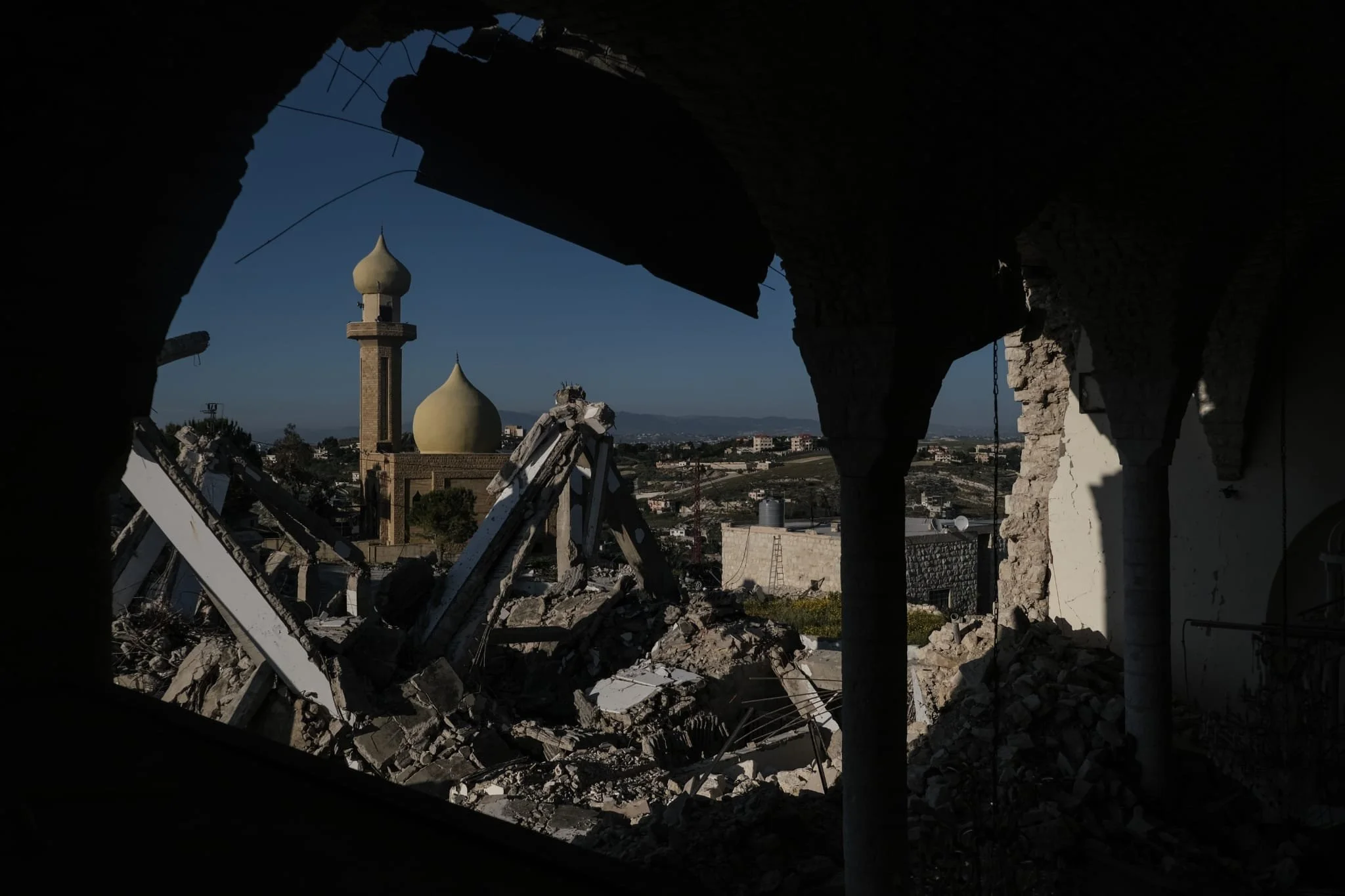
João Sousa. From the “Lebanon” series. Published in Al Jaliah, n.1, 2026.
The third image of João Sousa’s photo essay recently published in Al Jaliah’s latest issue depicts a war-torn city from within a ruined building. Slightly dislocated to the left of the frame, behind an upside-down triangular piece of debris, a mosque stands tall, overlooking the rural landscape in the background. The photograph was taken in 2024 or 2025, amidst the Zionist attacks over Lebanon. Sousa is a Portuguese photographer based in Lebanon. More specifically, he lives in the south of the country with his Lebanese wife and two daughters. Lebanon is his home, one whose very existence he sees endangered the more the Zionist Entity imposes itself in its colonial plan.
The series of eleven photographs kindly offered by Sousa to the magazine was articulated so as to resonate with the introductory text offered by the author, in which he describes the turmoil and strife generated by Israeli aggression; the family wonders whether they should have returned to Lebanon from Portugal, how to deal with imminent losses and how to help the children cope with reality. In the end, a statement that, at least from the viewpoint of Brazilian Lebanese, strikes close: “We rebuild every day.” Back in 2020, while the explosion of the Beirut port was heavily observed by news outlets, the image of the city as a legendary phoenix that continually revived from its own ashes was repeated extensively. Social media flooded with praises for the Lebanese tenacity and hopes and prayers for the city and its people to get back on its feet. The Brazilian government rushed to send humanitarian aid, personally delivered by former president Michel Temer, himself a child of Lebanese parents from the south.
Today, the ongoing invasion of Lebanon, though ushering in demonstrations of sympathy towards Lebanon, does not seem to have touched the Lebanese community enough, restricted to progressive centre-left circles. A WhatsApp group focused on geopolitical issues of the Middle East that I am myself part of continuously points out the silence of the Lebanese clubs in Brazil. As I have observed elsewhere in this very magazine (Racy, 2025), it seems that our empathy regarding continuous violence, harassment and abuse has an expiration date; we get tired of suffering, and simply decide to look the other way. Insensitivity has, indeed, become a virtue. Why would that be, however?
There is no easy way to answer this question. Psychologists, historians, anthropologists, sociologists, and philosophers would probably be the first researchers we would turn to so that we could make the current situation slightly comprehensible. We are creatures who tend to rationalize, to order the contents of the world so that we can derive sense from it. Whether our thoughts are domesticated or savage (Lévi-Strauss, 1984), we seldom tolerate chaos. The arts and crafts also help us experience and, in one way or another, understand the facts of the world. Agreeing with Wittgenstein, if every product of thought is public, because it exists as an action in the world, if everything we do is matter, then the boundaries between the emotional and the rational are blurred, and ought to be thought anew, from the outset of a corporeal materialism that understands our life in this world not as useful, but as an ongoing process of objectivation of our own self, an embeddedness in the one and only world we have at our disposal.
Thinking and feeling, therefore, must be reframed. And it is hard to do so under the aegis of late capitalism. Sometimes, however, history is able to expose itself in the minor details; in the geometry of a pictorial composition or in the structure of a musical tonal — or atonal — progression. Signs are given meaning by the meaning they enact. Though we may think that the possibilities for their combination are limitless, they are not or, at least, they feed into one another, actualizing themselves, causing a caesura in chronological time and warping into the kairological one.
Sousa’s photographs — specifically the third image in the aforementioned essay — are able to operate this caesura. They do so, in my view, as the contrast between the darkened space within the ruins and the light-blue-skied landscape with the imposing mosque brings me back to at least two historical images: one by Édouard Baldus, the famous 1851 photograph of the Cloister of St. Trophîme in Arles, and one by Raymond Depardon, in his famous series Beyrouth, Centre-Ville.
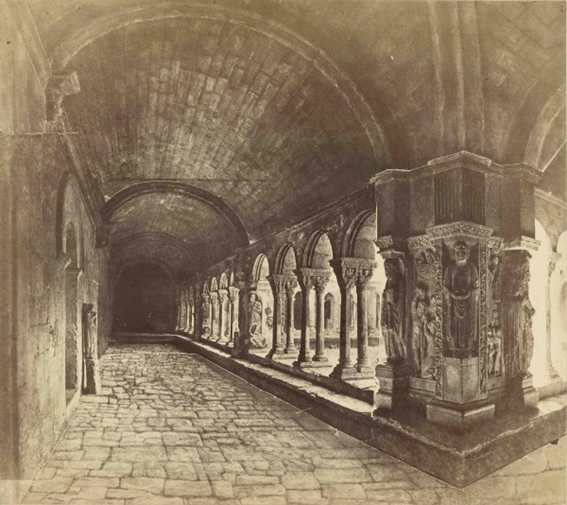
Edouard Baldus, Cloister of St. Trophîme, Arles, 1851. Albumen print from ten wax-paper negatives, 14 1/2 x 16 1/2 in. (36.8 x 42 cm). The J. Paul Getty Museum, Los Angeles.
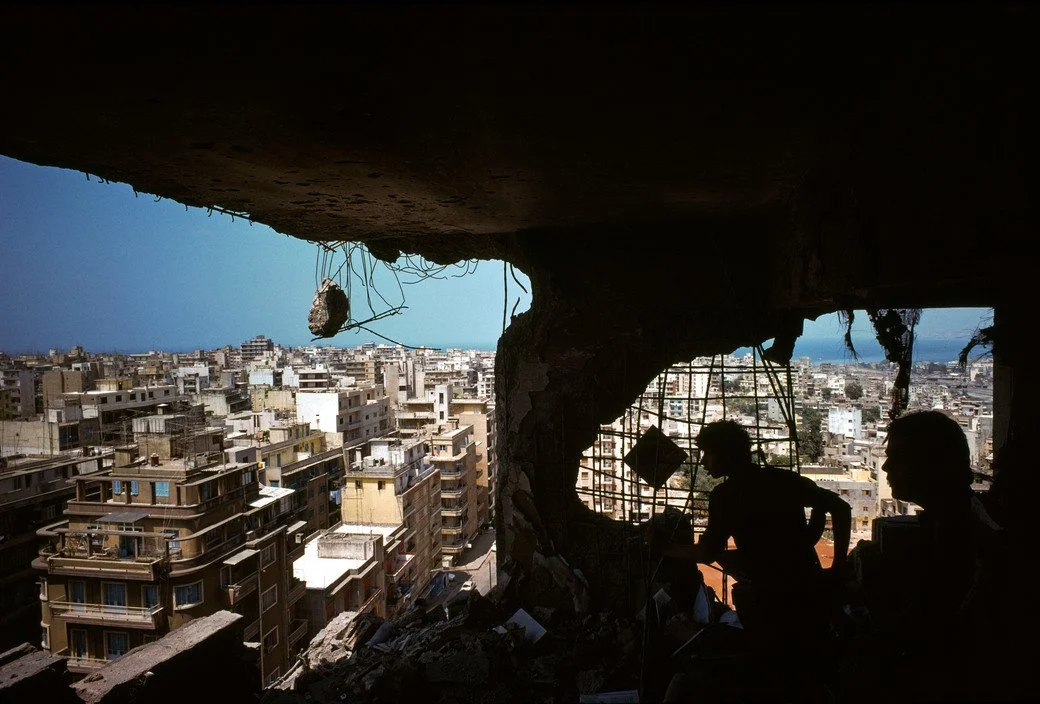
Raymond Depardon. Beirut, 1978. Low resolution reproduction of copyrighted image, Magnum Photos
Of course, the similitude between Sousa’s and Depardon’s photographs may be more obvious, but I ask the reader to take some time and observe Baldus’s image. It emanates Walter Benjamin’s (1996a) famous aura; a singular moment of a singular object; the mark of authenticity, of uniqueness. The possibility of capturing the authenticity of the thing portrayed was bound to disappear, according to Benjamin, given the rapid transformation of photographic technology and its massification — processes that gave rise to the impossibility of processing the numerous stimuli offered by the administered world and the reification of the gaze with the industrialization of the photographic apparatus.
And here is where Baldus’s image strikes close to home. In the very French, nineteenth-century tendency of registering monuments, Baldus offers us a spectral image of a cloister that makes one think about the juxtaposition of chronological time. A medieval cloister, looked at by a nineteenth-century photographer, looked at, on its turn, by us, in 2026. Is it a ruin we are looking at? Is it the remains of a time long gone? Is the photograph itself not a ruin? Here is where I want to establish the relationship between such different photographs as Baldus’s and Sousa’s. In a Barthesian sort of way, something that anchors me in both images, something that pierces my gaze, seems surprisingly similar, and repeats itself in Depardon’s image. The arches, whether standing tall, in the case of the cloister, or destroyed, in the case of Depardon’s and Sousa’s photographs, invite me to roam, to cross the derelict historical time and geographical space that should distance me from such views.
It is not that Depardon’s and Sousa’s images have managed to capture what Benjamin had called aura, but that perhaps the aura — if it indeed existed and was captured in early photographs such as Baldus’ — left an index on my own gaze that allows me to unveil correspondences between then and now, here and there, and back again.
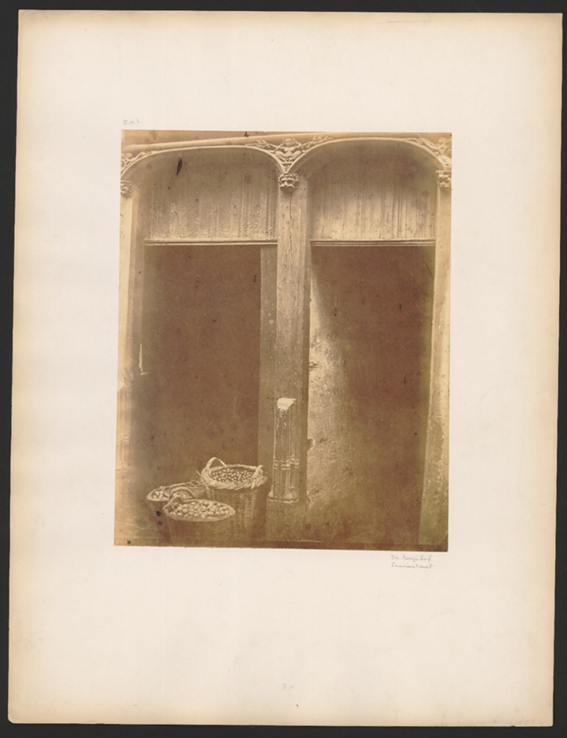
Edmond Fierlants, Saucierstraat, 1860. Erfgoedbibliotheek Hendrik Conscience, Antwerpen.
Ten years ago, while I prepared my PhD thesis (Racy, 2018), I came across a photograph of the Sauciestraat in Antwerp, taken by Edmond Fierlants. Then, as now, I believe the photograph — portraying an open door with impressive negative space as the main subject — was a photograph of nothing, if such a thing is possible; an image of negative space as a passage, as a threshold. Such an image has struck me ever since, and I have become constantly interested in photographs of paths, crossroads and archways. They represent, to me, thresholds, passages between places and, more importantly, the meaning of photographs as ruins.
Ruins, as Walter Benjamin (1999, 1996b) once observed, are that through which we transmit our experiences. Whether they are able to transmit our whole existence or not — the contradiction between Erfahrung and Erlebnis in Benjamin’s diagnosis of modernity — matters little. It matters, first and foremost, that they are able to bear witness to their own historicity and, in so doing, tie our own times to earlier ones, all the while prefiguring the future. If it is true, as Marx observed, that every epoch dreams its future, then I see, prefigured in the third image of Sousa’s series, the future of a Lebanon that stands tall. It does not emerge from its own ruins; it is not, in the end, a phoenix. It is not mythical, but historical. It inhabits its own ruins. Like the mosque in João Sousa’s image — it could be a church, a school, or a football pitch — it lingers, and it will do so in many forms, as long as this photograph can carry on, itself a ruin which we can also inhabit, and rebuild every day.
References
BENJAMIN. W. (1996a). “Pequena História da Fotografia”. Magia e Técnica, Arte e Política. Obras Escolhidas, Vol. 1. São Paulo: Brasiliense.
_______. (1996b). “Experiência e Pobreza”. Magia e Técnica, Arte e Política. Obras Escolhidas, Vol. 1. São Paulo: Brasiliense.
_______. (1999). “Rua de Mão Única”. Rua de Mão Única. Obras Escolhidas, Vol. 2. São Paulo: Brasiliense.
LÉVI-STRAUSS, C. (1984). O Pensamento Selvagem. Rio de Janeiro: Papirus.
RACY, G. (2025). “Reading Sebald in Times of Genocide”. Al Jaliah Blog. Available at: https://www.aljaliahbr.com/blog/reading-sebald-in-times-of-genocide
_______. (2018). City-Photography-Modernity. Visualizing Antwerp and São Paulo through the lenses of Edmond Fierlants (1819-1869) and Militão Augusto de Azevedo (1837-1905). PhD in the Social Sciences, Faculty of Social Sciences, Department of Communication Studies.. Supervisor: Paolo S. H. Favero. Universiteit Antwerpen. Available at: https://repository.uantwerpen.be/desktop/irua
Gustavo Racy is a professor at the Department of Anthropology at the Federal University of Paraná. He has a PhD in Social Sciences (University of Antwerp, 2018), and is a researcher on visual culture, capitalism, and political anthropology. Since 2024 he is the co-director of Al Jaliah.
